
The typical EV charging cost in the US is about $915 a year, or $76 a month, for 12,000 miles in an electric SUV rated at 3.2 miles per kWh, when 80% of the energy comes from home at 17 cents and the rest from public DC fast chargers at 54 cents. That works out to 7.6 cents a mile, against 11.5 cents for a 27 mpg gas car at $3.10 a gallon. A full charge at home runs about $13.69; a 10 to 80 percent fast stop, $29.26.
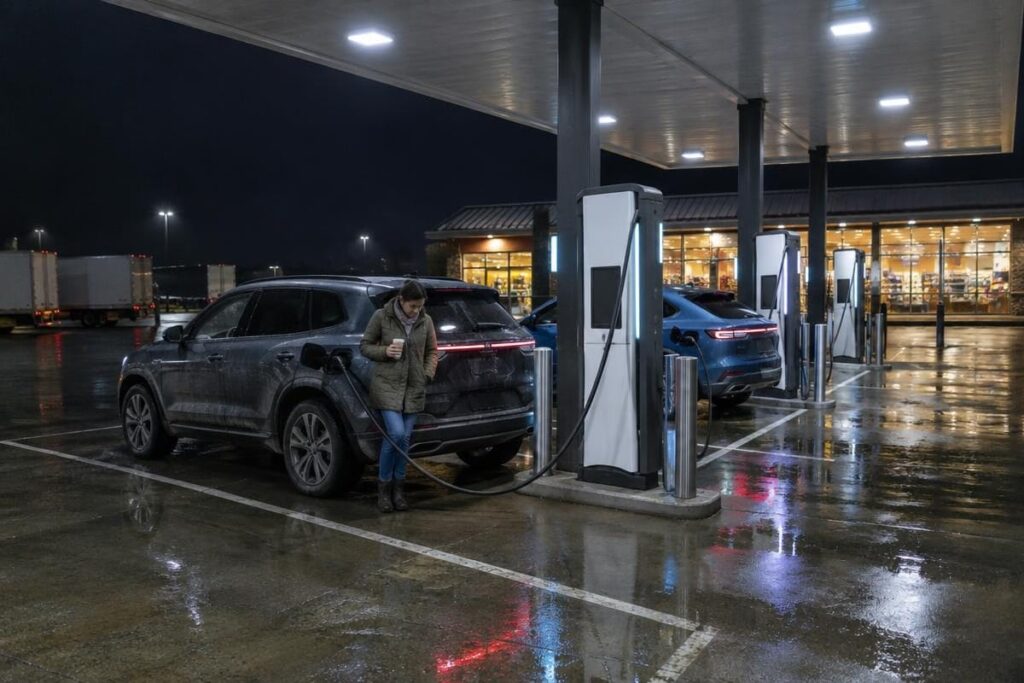
Enter your miles, the efficiency from the window sticker (or your car’s display), your home charging share and your state. You get the cost per year, month, mile and full charge, the home and public split, the added load on your electric bill, time-of-use savings, charging time and Level 2 payback. Blank rate fields use your state’s average electricity and fuel prices.
EV Charging Cost Calculator
Enter your miles, your EV's miles per kWh and how much you charge at home; the estimate gives the cost per year, month, mile and full charge, the home vs public split, time-of-use savings and the gap to a gas car.
Your Estimate
Estimates only, not a quote. Built from 2026 planning figures: state average residential electricity and regular gas prices, a mid 2026 national DC fast price, published wall-to-battery efficiencies (Level 1 83.8%, Level 2 89.4%, DC fast 93%) and AFDC charger power ratings. Utility fixed charges, demand charges, idle fees, network memberships, taxes on public sessions and battery wear are not modeled.
How Much Does It Cost to Charge an EV? Per Charge, Month and Mile
The cost to charge an electric car is miles divided by efficiency, times the price per kilowatt-hour. A kilowatt-hour (kWh) is the unit your utility bills and most public stations sell. The EPA lists electric vehicle efficiency as kWh per 100 miles; divide 100 by it to get mi/kWh (31 kWh per 100 miles is 3.2).
| Unit | EV, 80% home | EV, all home | Gasoline, 27 mpg |
|---|---|---|---|
| Cents a mile | 7.6 | 5.3 | 11.5 |
| Per 100 miles | $7.63 | $5.31 | $11.48 |
| Per month | $76.25 | $53.13 | $114.81 |
| Per year | $915 | $638 | $1,378 |
Battery size, not range, sets the price of a fill. The average EV across all model years holds about 72 kWh (2025 models average 92.6 kWh, per Recurrent). To fully charge 72 kWh from empty takes about 80.5 kWh from the wall, because Level 2 charging delivers roughly 89% of what the meter records; at 17 cents that is $13.69.
Home vs Public Charging: 20% of the Miles, 44% of the Bill
Public plugs move the cost of charging an EV more than anything else. In the example, the 9,600 miles charged in the garage come to $510, while 2,400 miles on fast chargers run $405. One fifth of the driving makes up 44% of the spending.
Public DC fast charging averaged 53.8 cents per kWh in the second quarter of 2026 (Paren). AAA’s daily average for all public charging stations, Level 2 and fast combined, was 42.2 cents on October 1, 2026.
With no plug at home, the example comes to $2,025 a year, $647 more than fueling the 27 mpg SUV. For total cost of ownership and break-even mileage, the electric vs gas car calculator uses the same charging prices, so the two pages agree.
How Public Chargers Bill a Session
The price on the network app is rarely the whole charge. Four billing parts decide what a public stop really costs:
- Per kWh: the clean case, and the number the calculator expects.
- Per minute: used where a state or site does not sell by energy, often in power tiers, so a car that charges slowly in the cold pays for time it is not adding range.
- Idle fees: a per minute penalty once the session ends and the car stays plugged in.
- Memberships: Electrify America Pass+ and EVgo plans trade a monthly fee for a lower rate; Tesla Supercharger prices also change by location and hour.
To test a membership, divide the monthly fee by the discount on each kWh. The answer is how many kWh you must buy each month before the plan pays. The example driver buys about 62.5 public kWh a month (750 a year), so only a small fee with a deep discount clears that bar. For a per minute charger, convert to cents per kWh from the session receipt (total paid divided by kWh delivered) before you enter it.
EV Charging Costs by State
The table runs the default inputs with each state’s 2026 average home electricity rate and pump price; public charging stays at 54 cents.
| State | Home rate, cents a kWh | Cents a mile, all home | Per month, 80% home | Yearly saving vs gasoline |
|---|---|---|---|---|
| Washington | 12 | 3.8 | $63.75 | $1,102 |
| Louisiana | 12 | 3.8 | $63.75 | $435 |
| Texas | 15 | 4.7 | $71.25 | $345 |
| US average | 17 | 5.3 | $76.25 | $463 |
| New York | 25 | 7.8 | $96.25 | $245 |
| Massachusetts | 30 | 9.4 | $108.75 | $51 |
| California | 32 | 10.0 | $113.75 | $657 |
| Hawaii | 42 | 13.1 | $138.75 | $313 |
The cheapest state to charge is not always where an EV saves most. Louisiana and Washington share a 12 cent rate, but with gasoline at $2.70 Louisiana drivers save $435, while Washington’s $4.20 pump price leaves $1,102. Massachusetts is the warning: at 30 cents a kWh and $3.05 fuel, an EV that charges 20% in public saves $51 a year. California power is expensive, yet $4.55 fuel keeps its gap at $657.
Time-of-Use Rates and Your Electric Bill
Home charging at the example mileage adds about 250 kWh and $43 a month to the household bill, 28% more than the 899 kWh a typical home uses (EIA).
A time-of-use (TOU) plan prices power by the hour: high in late afternoon, low overnight. Most cars and wall units can be scheduled to start after midnight. Arizona Public Service lists an off-peak price near 12.3 cents against the state’s 15 cent average; charging overnight at that rate cuts the yearly bill from $855 to $774, an $81 saving.
Read the tariff before switching. PECO’s 5.3 cent super off-peak price is its price to compare for supply, and delivery charges come on top, so enter the all-in figure.
Level 1, Level 2 or DC Fast: Charging Time and Losses
The level decides speed far more than cost. The Alternative Fuels Data Center rates the power of each level; range per hour below assumes 3.2 mi/kWh, and efficiency is the share of metered energy that reaches the battery.
| Level | Power | Range per hour | Full charge, 72 kWh | Efficiency |
|---|---|---|---|---|
| Level 1, 120 V | 1.9 kW | 6 miles | 45.2 hours | 83.8% |
| Level 2, 240 V | 7.2 kW | 23 miles | 11.2 hours | 89.4% |
| DC fast | Up to 500 kW | 100 to 200+ miles per 30 minutes | 10 to 80% in 18 to 35 minutes | 93% |
Charging losses are where many guides double count. The EPA rating is measured at the wall, so the loss is already in it. Your car’s trip screen counts energy leaving the battery and leaves the loss out. Pick “my car’s display” as the efficiency source and the tool adds the loss back: the example rises from $915 to $1,006 a year on a 240 V unit and $1,044 on a 120 V cord, a $38 gap. Cold matters more; a European Commission test measured efficiency under 40% at minus 13 degrees F.
Level 2 Home Charger Installation Costs and Payback
A Level 2 charger usually runs $1,000 to $2,500 installed, with most homeowners paying $1,200 to $1,800, per a July 2026 installer price guide. Hardware is $300 to $600; the rest is a dedicated 240 V circuit, labor and a permit ($25 to $300). A 100 to 200 amp panel upgrade adds $2,000 to $3,800.
On efficiency alone, $38 a year would take over 30 years to recover $1,200. The real return is overnight refills that keep you off public plugs: against paying 54 cents for those 9,600 home miles, the install pays back in 13 months. AFDC puts a 120 V outlet at about 5 miles of range an hour, roughly 40 miles over an 8 hour night, so an EV driver who covers under 40 miles a day may never need the upgrade. The federal 30C credit (30%, up to $1,000) ended for chargers placed in service after June 30, 2026, per the IRS Form 8911 instructions; ask your utility about rebates.
Start with your last utility statement: divide the total by the kWh used, enter that rate and the share of the time you can charge your EV at home. Then rerun the EV charging cost estimate at 0% home to see your exposure if you lose access to a plug, and check the full picture in the cost of car ownership calculator. The gas cost calculator prices the same miles in a gasoline car.
Questions About Charging an EV
How much does it cost to fully charge an electric car?
About $13.69 at home for a 72 kWh battery from empty at the 17 cent US average on a 240 V charger, losses included: $9.66 in Washington, $33.83 in Hawaii. A 10 to 80 percent DC fast stop costs about $29.26 at 54 cents a kWh.
How much does it cost to do 100 miles in an electric car?
At 3.2 mi/kWh, 100 miles uses about 31 kWh: $5.31 at the US home rate, $16.88 on fast chargers and $7.63 at an 80/20 mix. A 27 mpg gasoline car spends $11.48 at $3.10 a gallon.
Is it cheaper than gas to charge an EV?
Yes, when most charging is at home. At US averages, an electric SUV charged 80% at home saves $463 a year over a 27 mpg gas SUV. Running only on public fast chargers costs $647 more a year than gasoline.
Is it cheaper to charge an EV at home or at a public charging station?
Home, almost everywhere: the cost per kWh averages 17 cents on a residential meter versus 54 cents for DC fast charging and 42.2 cents across all public plugs. Free workplace plugs are cheaper still; the tool treats them as home share.
How much does charging an EV add to your electric bill?
About 250 kWh and $43 a month at 12,000 miles with 80% charged at home at 17 cents, roughly 28% on top of the 899 kWh a typical home uses.
Can solar panels make home charging free?
No, because solar power you put into the car is power you did not sell back. Its real cost is the export credit your utility pays. Under full retail net metering that is close to your normal rate; under export tariffs such as California’s net billing, midday exports earn far less, so daytime solar charging is cheap. Enter that export value as the home rate.
Estimates only, not a quote. Figures use 2026 state planning averages for electricity and fuel; your tariff, network prices, fees, taxes and weather change the result. Last reviewed: October 2026.