
Car dealer fees are the charges added to a vehicle’s price at signing: some set by the state, one by the manufacturer, the rest by the dealership itself. The paperwork charge is the one every buyer meets, and it runs from an $85 cap in California to a typical $900 in Florida. To see how each line moves your final number, run the deal through the out the door price calculator and check the tax with the car sales tax calculator.
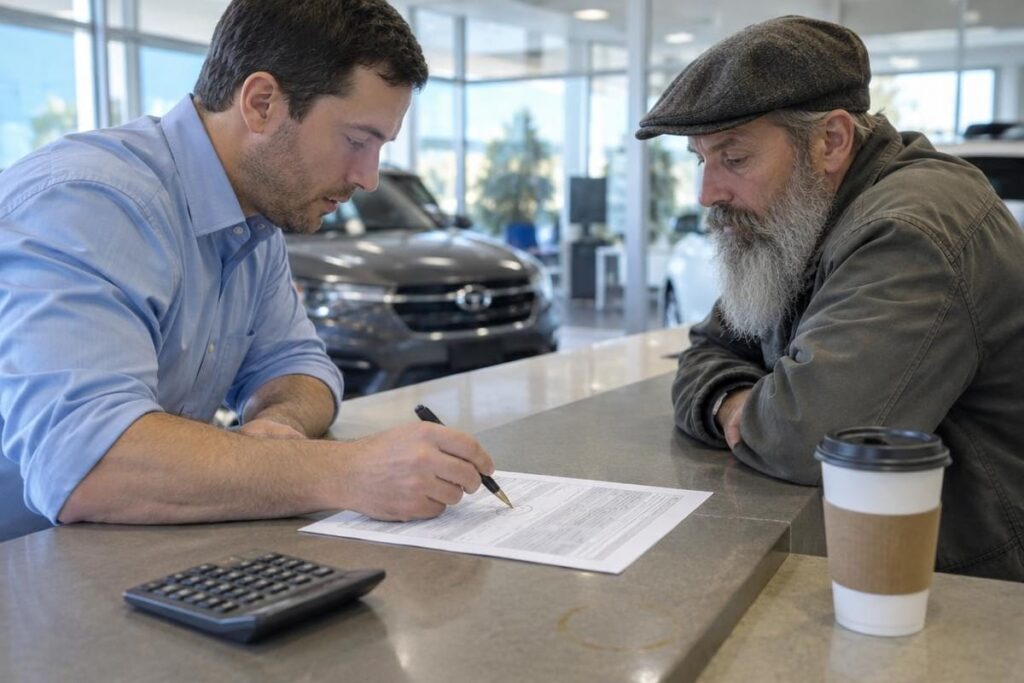
How Much Are Dealer Fees on a $35,000 Car?
Expect to pay about $2,700 on top of a $35,000 negotiated price at US typical figures, and only $400 of it is the dealer’s own charge. The government gets the rest.
- Sales tax at a 5.75% typical rate: $2,012.50
- Title and registration: $310 ($40 title, $270 first-year registration)
- Documentation charge: $400
- Total cost out the door: $37,722.50
The doc fee is 14.7% of those $2,722.50 in extras, yet it gets most of the arguing. Move the same purchase from California to Florida and that one line swings $815.
A used car carries the same common fees as buying a new one, minus the destination charge. On used vehicles the paperwork charge looms larger, because it’s a flat amount on a smaller price. If you haven’t settled on the vehicle type yet, the new vs used vs CPO comparison covers the other cost differences, and the used car loan calculator shows what a financed doc fee adds to an older car’s payment.
Common Dealer Fees When Buying a Car, Line by Line
Each line falls into one of four groups, and the group decides whether arguing works.
Set by the state: pay as billed
- Sales tax. The state sales tax rate plus any county or city rate, figured on the taxable price. Most states subtract a trade-in first (the car loan trade-in calculator shows that tax credit); California does not.
- Title and registration fees. The title records you as owner; registration and plates let you drive. The Department of Motor Vehicles (DMV) sets both, and the seller only collects them.
- Delaware’s “document fee”. Despite the name, it’s a state levy charged in place of sales tax, not the dealer’s paperwork charge.
No one at the car dealership can discount or mark up a state or local government charge. If the title line is above your state’s schedule, ask for the DMV receipt, or check the expected amount first with the vehicle registration fee calculator.
Set by the manufacturer: destination
A destination fee is the shipping charge for moving a new car from the plant, billed by the manufacturer to the dealer and passed on to you. Federal law puts it on the window sticker (the Monroney label) next to the suggested retail price, under 15 U.S.C. 1232. Every buyer of that model pays the same amount. What the sticker won’t tell you is whether the store added its own “freight” or “delivery” line on top; that second line is pure store margin, not a factory charge.
Set by the dealer: the lines with room
- Documentation fee (doc fee). The charge for preparing the sales contract, title paperwork and lien filing. Capped in 13 states; elsewhere the seller picks the number.
- Processing fees, e-filing or “dealer service” charges. Often a second paperwork line. Ask what it covers that the first one does not.
- Advertising fee. Your share of the store’s regional advertising, passed along. It isn’t on the sticker, so treat it as part of the price of the car.
- Dealer prep or reconditioning. On a new vehicle this is normally part of the seller’s own cost; on a used one it belongs in the asking price.
- Market adjustment. A markup above sticker on scarce models. Pure margin.
Optional products: any add-on can be declined
- VIN etch. The vehicle identification number etched into the windows as a theft deterrent. Many cars already have it.
- Paint, fabric and tire protection. Coatings and nitrogen fills sold as packages, often pre-installed.
- Extended warranty. A service contract covering repairs after the factory warranty ends, also sold later by other providers.
- GAP insurance. Guaranteed asset protection covers the gap between the loan balance and an insurance payout if the car is totaled. Worth a look with a small down payment on an auto loan, and often cheaper from your own insurer or lender.
Some of these dealer add-ons cover the cost of real services, but every one is optional. If one is pre-printed on the paperwork, ask the dealer to remove it and reprint.
Car Dealer Fees by State: Doc Fee Caps for All 50 States and DC
Thirteen states cap the dealer documentation fee by law, so what you pay can vary by state by more than $800 for identical paperwork. In the other 37 and DC, the figure below is a typical quote, not a limit; Florida, Virginia, New Jersey and North Carolina top that group.
| State | Typical or capped charge | Capped by law |
|---|---|---|
| US typical | $400 | No |
| Alabama | $400 | No |
| Alaska | $250 | No |
| Arizona | $450 | No |
| Arkansas | $129 | Yes |
| California | $85 | Yes |
| Colorado | $600 | No |
| Connecticut | $600 | No |
| Delaware | $400 | No |
| District of Columbia | $500 | No |
| Florida | $900 | No |
| Georgia | $600 | No |
| Hawaii | $300 | No |
| Idaho | $300 | No |
| Illinois | $358 | Yes |
| Indiana | $200 | No |
| Iowa | $180 | Yes |
| Kansas | $400 | No |
| Kentucky | $400 | No |
| Louisiana | $425 | Yes |
| Maine | $500 | No |
| Maryland | $800 | Yes |
| Massachusetts | $450 | No |
| Michigan | $280 | Yes |
| Minnesota | $350 | Yes |
| Mississippi | $400 | No |
| Missouri | $500 | No |
| Montana | $300 | No |
| Nebraska | $400 | No |
| Nevada | $500 | No |
| New Hampshire | $400 | No |
| New Jersey | $700 | No |
| New Mexico | $400 | No |
| New York | $175 | Yes |
| North Carolina | $700 | No |
| North Dakota | $250 | No |
| Ohio | $250 | Yes |
| Oklahoma | $400 | No |
| Oregon | $250 | Yes |
| Pennsylvania | $490 | Yes |
| Rhode Island | $400 | No |
| South Carolina | $400 | No |
| South Dakota | $200 | No |
| Tennessee | $600 | No |
| Texas | $250 | No |
| Utah | $300 | No |
| Vermont | $300 | No |
| Virginia | $800 | No |
| Washington | $200 | Yes |
| West Virginia | $500 | No |
| Wisconsin | $300 | No |
| Wyoming | $400 | No |
- Some caps are a percentage too. Ohio limits the charge to the lesser of its dollar cap or 10% of the deal (ORC 4517.261), Minnesota to the lesser of $350 or 10% of the sale value, and Michigan to the lesser of $280 or 5% of the cash price. On an $1,800 used car in Ohio, that holds it to $180; on a $3,000 one in Michigan, $150.
- Several caps rise with inflation. Pennsylvania publishes a new limit each year, indexed to the Consumer Price Index (PA notice, January 2026): $490 for 2026 when the paperwork is filed electronically, $409 when it isn’t. Illinois and Ohio index theirs too, and Michigan adjusts its cap every two years. Indiana, listed as uncapped, takes no enforcement action on charges at or below $261.72 as of July 1, 2026. Check the current year’s figure before you sign.
- Texas uses a benchmark, not a cap. A charge of $225 or less is presumed reasonable by the state’s consumer credit office; above that, the seller must file a cost analysis.
Which Dealer Fees Are Negotiable, and Which Are Not?
Government and manufacturer lines are fixed. The store’s own lines are the fees you can negotiate, but they usually move through the car price rather than one by one.
- Fixed: sales tax, title, registration, inspection and destination on new models. A lower number here is an error, not a discount.
- Fixed per buyer, open on price: the doc fee. Pennsylvania’s notice calls it “a negotiable item” and bars pre-printing the amount on the buyer’s order. It still rarely comes off for one buyer. The reason is consistency, not stubbornness: a store that waives it for you has a harder time defending it to the next customer or a regulator, so most dealers charge everyone the same figure (Pennsylvania showrooms must even post it on a sign). You may be able to negotiate the equal sum off the price of the vehicle instead.
- Removable: advertising, prep, market adjustment and anything you didn’t ask for.
- Refusable: every add-on and optional product, before you sign. Afterward, cancellation depends on the contract.
These charges are negotiable only as part of the total. Ask for one out the door price in writing and compare stores on that number. A salesperson who “waives” a few hundred dollars of charges and adds them back to the price hasn’t given you anything.
Are Dealership Fees Taxable?
Sometimes, depending on the state, and the difference shows up on the sales tax line. Pennsylvania says its doc fee “is non-taxable.” Texas leaves a separately stated documentary charge out of the taxable price (Texas Comptroller). Maryland goes the other way: its Motor Vehicle Administration counts the dealer processing charge in the taxable price (MVA bulletin, April 2026).
Ads differ too. Indiana requires the paperwork charge inside the advertised sale price and as its own line on the bill of sale (Indiana Secretary of State, July 2026). Pennsylvania lets sellers leave it out of the ad, so two identical ads in those states can mean different totals.
Does the FTC CARS Rule Limit Dealer Fees?
No. The Combating Auto Retail Scams (CARS) Rule, which the Federal Trade Commission (FTC) finalized in December 2023, never took effect. The U.S. Court of Appeals for the Fifth Circuit vacated it on January 27, 2025 (Fifth Circuit opinion), holding that the agency skipped a required step: an advance notice of proposed rulemaking.
Had it survived, the rule would have required an offering price that included every charge except government fees, banned add-ons that give the buyer no benefit, and required express consent for each extra charge. A fee guide that presents those protections as current law is out of date.
The part people misread is why it fell. The court ruled on procedure and never decided whether the practices it targeted are legal. Section 5 of the FTC Act still bans deceptive pricing, and state consumer protection laws plus the doc fee caps above still apply. What buyers lost is the all-in price requirement, which is why asking for a written out the door total still matters.
How to Spot Additional Fees on the Sales Contract
- Get the buyer’s order before the finance office, the last car-buying stop. Lines are easiest to strike before the contract prints.
- Match the window sticker. Price, destination and any addendum should agree with the sticker and the VIN on the vehicle.
- Read the fine print for duplicates. Two paperwork charges, or “freight” on top of destination, are the usual repeats.
- Ask the dealer to clarify any line you don’t recognize, in writing. A charge nobody can explain should come off.
- Check the amount financed. Products rolled into the loan raise the payment a few dollars a month and the total much more, so test the bigger balance in the car affordability calculator first. Paying the paperwork charge from savings is sensible; draining an emergency fund to avoid financing a few hundred dollars is not.
Before you buy a car, start with the state table above, then ask two dealerships for an itemized out the door price on the same new or used model. Strike every add-on you didn’t request, and compare totals rather than single lines. Plug the result into the out the door price calculator to see how car dealer fees and tax change your payment, or use the sales tax calculator for the tax alone.
Car Buying Fees: Common Questions
Can you refuse to pay dealer fees?
You can refuse add-ons and optional products, and ask to remove advertising, prep or market adjustment lines. Tax, title, registration and destination can’t be refused. The paperwork charge is rarely removed, so negotiate the price instead.
Do dealerships include registration in the price?
Not in the advertised price, in most cases. The store collects title and registration at signing and passes them to the state, so they appear as separate lines on the out the door quote.
What if a dealer charges more than the cap?
Ask for the excess to come off before you sign. If the store refuses, complain to the state agency that licenses vehicle sellers or to your attorney general’s consumer protection office.
What extra fees should you avoid at a car dealer?
Skip any line that duplicates another or buys you nothing: a second paperwork or “e-filing” charge, freight on top of the factory destination line, an advertising fee, market adjustment, and pre-installed coatings or nitrogen fills you never asked for. Legitimate fees are tax, title, registration, destination and, where it’s charged to everyone, the doc fee.
Can a dealer change the price after you sign?
Generally not; the signed contract fixes the price and charges. The exception is conditional delivery (often called spot delivery), where the contract makes the deal depend on the dealer finding a lender. If that financing falls through, you may be asked to sign new terms, and state law decides your options, so read that clause before you drive away.
Estimates only, not a quote. Caps follow the latest state statute or regulator notice we found; other figures are typical quotes. Your contract sets the final amount. Last reviewed: November 2026.